Digitising the Schiller Collection
Posted on by Fay Whitfield.
By Elisa Ricci, Documentation Assistant at Bristol Museum & Art Gallery (2024-2025)
In June 2024, we launched a project to complete digitisation of the Schiller Collection. This is the most significant collection in the Asian Art Department at Bristol Museum & Art Gallery (BMAG).
 The project was funded through Bristol Museums Development Trust thanks to an anonymous legacy, John and Susan Hart and the Sir Percival David Foundation Academic and Research Fund.
The Schiller Collection numbers about 600 objects. Our aim is to make it more accessible by uploading new, high-quality images and updating the records in our database with more information on the collection.
Over the last 11 months, we have successfully digitised and updated 176 objects, most of these Chinese. Also, we have made all the images available on our collections website which is free to use. We hope this process will help students, researchers and audiences around the world discover and study the collection.
The core of the Asian Art Collection at BMAG are the items donated by F.P.M. (Max) Schiller (1868–1946) in 1946. This includes 417 exceptional Chinese ceramics, jades, bronzes and other objects. Many of these objects are on display in the new Schiller Gallery. Other pieces are stored in our reserve collections for study and rotation in new displays.
Most of these pieces were collected in the 1910s and 1920s by F.N. (Ferdinand) Schiller (1866–1938), Max’s elder brother. Ferdinand had a particular interest in Chinese ceramics. His focus was especially on those with light and dark blue, yellow and green glazes from the Tang (A.D. 618–960) and Song (A.D. 960–1279) dynasties. He also collected fine rugs and antique furniture now displayed in the Schiller Gallery at BMAG, The Red Lodge Museum and The Georgian House Museum.
The Schiller pieces digitised in this project are more than everyday objects. Many are extraordinary miniature reproductions of vases, bowls, cups, animals, and other items typically found in tombs. In ancient Chinese culture, death held as much significance as life. Tombs, both ancient and more recent, often contain vessels with food and wine, personal belongings, and symbols of the deceased’s social status, intended to accompany them into the afterlife.
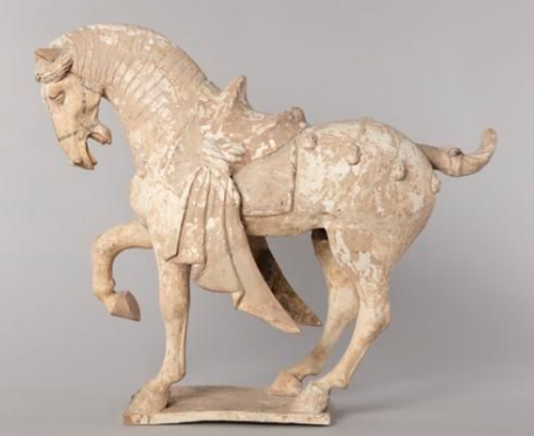 One of my favourite pieces that we digitised is this earthenware figure of a horse (N2372). This sculpture comes from a Chinese tomb and dates to the Tang dynasty (618–907 AD). Figures like this were often placed in tombs as ‘spirit objects’ to serve the deceased in the afterlife and reflect their status. What makes this piece particularly striking is its dynamic posture. The horse advances on a base with mouth open, ears alert, and right foreleg raised. The maker captured the movement and vitality of the animal. Through detailed photography we discovered that traces of pigment and gilding remain on the surface. These suggest that the entire figure was once vividly painted, probably in reds, greens, and gold.
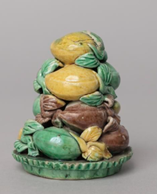 This small fruit pyramid (8 cm, N2656) was made in China between the late 17th and early 18th centuries. It is incredible to be able to admire its vivid glaze in yellow, green, and aubergine after all this time. Looking inside the pyramid, it is possible to make out that the fruits were moulded one by one. Small, colourful objects like this were used as offerings on altars or in tombs. In the past people believed that deities could not distinguish between real and porcelain fruit. This was an ingenious way to avoid wasting real fruit.
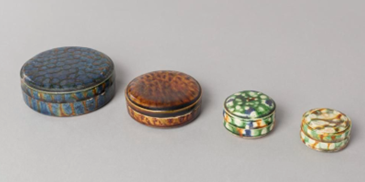 These lidded boxes (N2381, N2382, N2383, N2384) of different sizes and striking colours are from the Tang dynasty period (618-907). They are made of earthenware and decorated with sancai or ‘three colour’ technique. This decoration was achieved by adding metal oxides to a lead glaze. Potters used copper to obtain the green colour, iron for the amber or brown, and cobalt for the dark blue. These coloured glazes were also used for objects that contained perfume or make up. Small ceramics like these might be used for grounding up medicines or make up.
The ‘Sancai’ (three-colour) technique was exported from China to Japan and westwards to Sri Lanka, Samarra (modern Iraq) and Fustat (Cairo), where it inspired Middle Eastern copies.
This digitisation project has helped us to learn more about these Asian objects and share their beauty and stories with a wider audience through our collections online. By making the Schiller collection easier to access, we’re helping to protect it for the future and encouraging people to better understand the culture and history behind it.
Some of these pieces are on display in the Schiller Gallery at Bristol Museum & Art Gallery and more images are available to explore on our collections website.